THE GARIFUNA
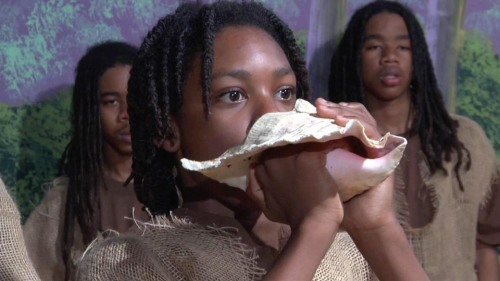
The history of the Garifuna (or Garifune) begins before the year 1635 on the island of
St. Vincent in the eastern Caribbean. St. Vincent was inhabited by a tribe of Indians who
called themselves Arawaks. The Kalipuna tribe from mainland South America invaded St.
Vincent and conquered the Arawaks. The Arawak men were all killed and the Kalipuna
warriors took the Arawak women as wives. The inhabitants of the island were then the union
of these two tribes. The word "Garifuna", which means "cassava eating
people", is probably descended from "Kalipuna". The Spanish called these
people "Caribes" (Caribs) which means cannibals and that is the word from which
"Caribbean" is descended.
In the year 1635 two Spanish ships carrying Nigerian slaves shipwrecked on the island
of St. Vincent. At first, the Spanish, Nigerians and Kalipuna fought one another but
eventually learned to get along and intermarried, thus creating the Black Caribs.
At that time, St. Vincent was a British colony and the Caribs tried to establish
independent control of the island. The French supported the Caribs and there were many
battles between the Caribs and the British. The greatest battle took place in 1795 and
both sides suffered great losses. In 1796 the Caribs and the French surrendered to the
British.
The British now had a problem. The Caribs were free men with black skin and St. Vincent
was populated by slave-owning Europeans. The idea of a group of free black men living
among them on the island was unacceptable so the British decided to deport the Caribs. The
British hunted down and rounded up the Caribs, killing hundreds in the process and
destroying their homes and culture. The remaining 4,300 Caribs were shipped to Balliceaux
where half of them died of yellow fever.
In 1797 the surviving Caribs were shipped to Roatan Island off the coast of Honduras.
Along the way, the Spanish captured one of the British ships which was taken to Trujillo
where the captured Caribs did well. Later, the Spanish captured Roatan Island from the
British. The Spanish rounded up 1,700 Caribs on the island and brought them to Trujillo
where laborers were much needed. The Spanish were not good farmers and Trujillo suffered
accordingly. On the other hand, the Caribs were very skillful at farming so they went to
work and did very well in Trujillo. Some of the Caribs were conscripted into the Spanish
army where they served with distinction.
The first Caribs to arrive on the coast of Belize were brought there as woodcutters by
the Spanish in 1802. They were put ashore in the area near Stann Creek and what is now
Punta Gorda. At the time, Belize was held by the British and was called British Honduras.
The Caribs continued to serve the Spanish army with distinction, earning medals of valor.
At one point, the fortress at San Felipe (El Castillo de
San Felipe) was commanded by a Carib. Gradually more Caribs
moved to the Stann Creek area in British Honduras.
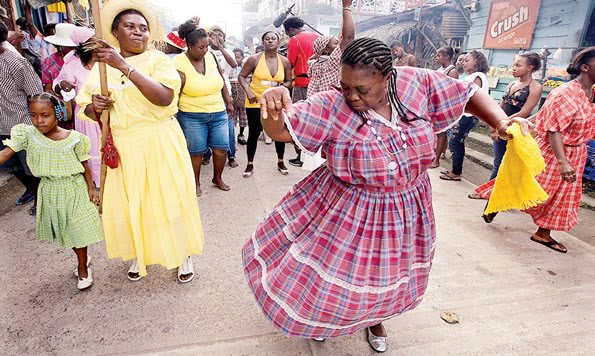 Because of their alignment with the Spanish, the Caribs found themselves on the wrong
side of the political fence when Central America achieved independence from Spain. Those
Caribs in Trujillo found themselves in the new country of Honduras where sentiments
against Spain were strong. Large numbers of Caribs fled to the coast of Belize where other
Caribs already lived in numbers. It is this migration that is celebrated annually as
Garifuna Settlement Day. This is a major holiday in Garifuna communities celebrated on
November 19th.
Because of their alignment with the Spanish, the Caribs found themselves on the wrong
side of the political fence when Central America achieved independence from Spain. Those
Caribs in Trujillo found themselves in the new country of Honduras where sentiments
against Spain were strong. Large numbers of Caribs fled to the coast of Belize where other
Caribs already lived in numbers. It is this migration that is celebrated annually as
Garifuna Settlement Day. This is a major holiday in Garifuna communities celebrated on
November 19th.
Gradually, the Caribs spread up and down the coast of Belize. During this century, some
Caribs served on US and British merchant vessels during World War II and travelled the
world. As a result, there are now small communities of Garifuna in Los Angeles, New
Orleans and New York City.
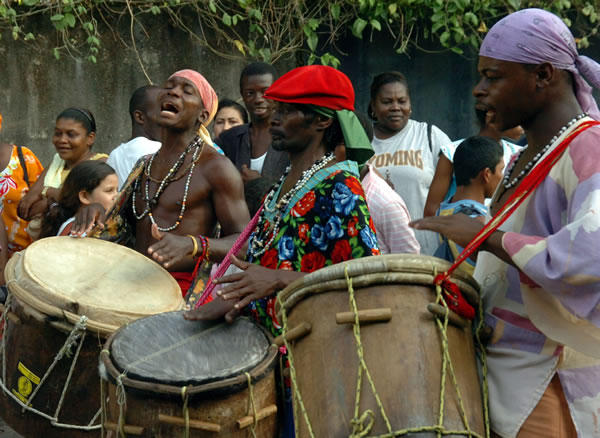 The Garifuna culture is very strong with great emphasis on music, dance and
story-telling and with its own brand of religion consisting of a mix of Catholicism,
African and Indian beliefs. Because of their difference and independence, over the years
the Garifuna have been feared and discriminated against by Guatemalans and variously
accused of devil-worship, polygamy, voodoo and speaking a secret language.
The Garifuna culture is very strong with great emphasis on music, dance and
story-telling and with its own brand of religion consisting of a mix of Catholicism,
African and Indian beliefs. Because of their difference and independence, over the years
the Garifuna have been feared and discriminated against by Guatemalans and variously
accused of devil-worship, polygamy, voodoo and speaking a secret language.
In 1996, Garifuna Settlement Day was especially important. The government of Guatemala
officially recognized the importance of the Garifuna community and President Arzu paid an
official visit to the town of Livingston. The Garifuna culture is a unique treasure.


